
Play
Puzzle school: how a Layton puzzle works
Read the question's last sentence first, turn every clue into an attribute, grid the options, then eliminate. Spend one hint, not three; Restart costs nothing.
A Layton puzzle is not a riddle. It is a small closed system: a few stated facts, one question, and a rule that makes exactly one answer correct. Most people who get stuck are not missing the trick, they are answering a slightly different question than the one printed.
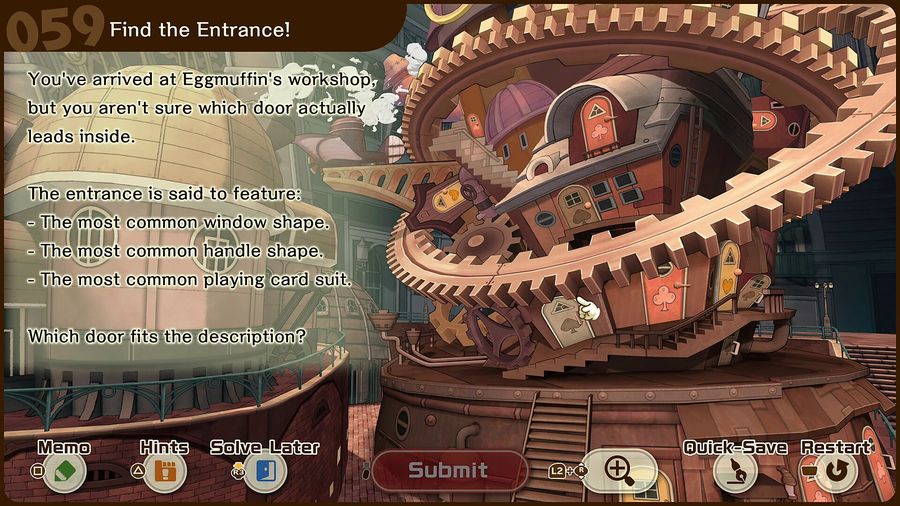
This page is the method, not the answers. It works on the series' puzzles generally, and every interface element named here is visible in the official screenshot of this game's puzzle screen: Memo, Hint, Solve Later, Quick Save, Restart.
Read the question twice, then read the last sentence
The question is always the final line. Everything above it is setup, and setup is where the traps live. Two habits fix most failures:
- Read the last sentence first, so you know what shape the answer takes: a number, a name, an object, a direction.
- Then read the setup looking only for what the question needs. Details that do not feed the answer are usually there to mislead you.
If the answer asks "how many", every sentence that does not change a count is decoration. If it asks "which one", build a list and cross off.
Turn the clue into a checklist, not a story
The official screenshot of this game shows a puzzle asking which door is the entrance. The clue is built out of attributes - a window shape, a handle shape, a card suit - and the doors differ in exactly those attributes.
That is the house style, and it gives you the method: list the attributes, then list the options, then eliminate.
| Step | What you do |
|---|---|
| 1 | Write down every attribute the clue mentions, as column headers |
| 2 | Write the options as rows |
| 3 | For each clue sentence, cross out rows that contradict it |
| 4 | Whatever survives is the answer - if two survive, you misread a sentence |
The Memo button exists for exactly this. Use it before you think you need it; the act of writing the grid forces you to notice which attribute you have not used.
Three ways these puzzles waste time
Reading a number as a count when it is a position. "Third" and "three" are different words for a reason.
Assuming real-world physics. If the puzzle says a machine works a certain way, that is the rule, even when it contradicts how a steam engine actually behaves.
Solving for the interesting answer. Layton puzzles often have a deliberately boring solution, and the elaborate one is the trap. If your answer requires three unstated assumptions, it is wrong.
When to spend a hint
The puzzle screen carries a Hint button and the store page describes Coindar as a robot that detects hidden hint coins, so the game is built around a hint budget. Spend it in this order:
- Restart the puzzle from scratch before spending anything. Most stuck states come from a wrong first assumption, and a clean read fixes them for free.
- Take one hint, then go back to the question. One hint usually names the attribute you ignored rather than the answer.
- Take the second hint only if you can name what you are missing. If you cannot, the problem is reading comprehension, not information.
- Solve Later exists when a puzzle has stopped being fun. Use it. It is a game, and the series has always let you walk away and come back through the menu.
Things not to do
Do not look up an answer for a puzzle you have not tried. The Layton series is built so that the solutions are the content - the story gates behind puzzles, and skipping them turns a 30-hour adventure into a slideshow.
If you are stuck on one puzzle for more than ten minutes, take one hint, then Solve Later, and come back the next day. The next-day effect on this kind of puzzle is real and well documented by anyone who has played the series.
After launch
Once the game is out, this page gains worked examples from the first chapter and a table of the puzzle types that appear most often. It will not become an answer key, and the page explaining that choice says why.