
Play
Ten families of Layton puzzle, and the tool for each
Classify before you solve. Ask how many candidates there are, whether the answer is a number or a choice, and whether there is a budget. Those three answers name the family, and the family names the tool.
Every Layton puzzle belongs to a family, and the family tells you which tool to reach for before you have read a single word of the setup. Recognising the family in the first ten seconds is the single biggest time saver in the series, and it costs nothing.
The puzzles in this game are written by QuizKnock, the group led by quiz champion Takushi Izawa, so the wording is tighter than the older games. The families below are the ones the series has reused for nineteen years, and each one has a method that works regardless of the specific dressing.
| Family | How you recognise it | The tool | The trap |
|---|---|---|---|
| Attribute match | Several candidates, each differing in fixed features | Tally table, one column per feature | Counting the wrong feature |
| Ordering | People, houses or times, plus relational clues | Grid with positions locked as you go | Assuming a total order when some are free |
| Weighing | A balance, limited weighings, identical-looking items | Divide into thirds, never halves | Weighing one against one |
| Pouring | Jugs of set sizes, a target volume | Work backwards from the target | Trying to reach it forwards |
| Route | A grid or a map, a marked start and end | Draw the path, count the moves | Assuming the shortest path is legal |
| Cut and fold | A shape, a fold line, a request for the result | Physically imagine the fold, or draw it | Folding the wrong half |
| Silhouette | A shadow, a request to identify the object | Rotate the object, not the shadow | Matching by outline only |
| Statement logic | Several speakers, some liars or one truth | Assume each in turn, look for the contradiction | Trusting the most confident speaker |
| Arithmetic in prose | A story with numbers buried in it | Strip the story, keep the numbers | Solving the story instead of the sum |
| Sliding or packing | Pieces, a container, a move budget | Solve the last move first | Improving a position that is already correct |
Attribute match: count, do not compare
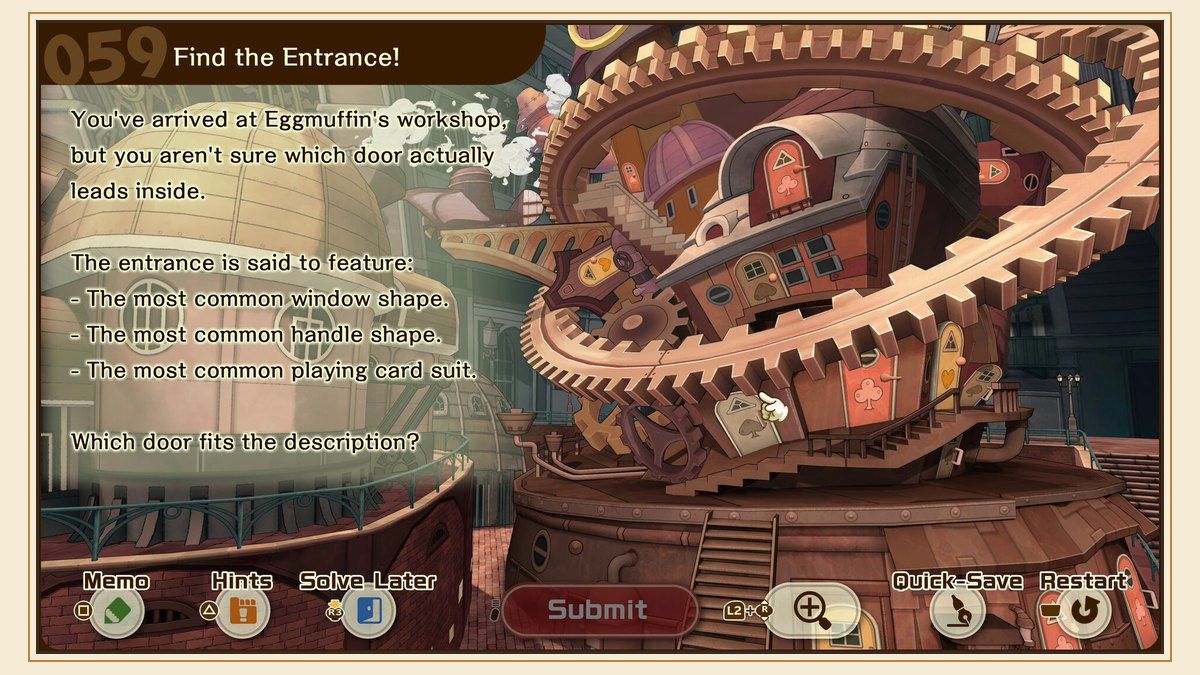
The screenshot on this site is one of these. It asks which door is the entrance, and the entrance is defined as having the most common window shape, the most common handle shape, and the most common playing card suit. Nothing about that is a riddle. It is three counts, and the answer is the door that wins all three.
The method is mechanical. Draw one column per feature, list the doors as rows, and tally. Do not eyeball it - the whole point of the puzzle is that eyeballing gives you the second most common answer. Puzzle 059 is walked through step by step here.
Ordering: lock what is fixed, then re-read
Ordering puzzles give you a set of positions and a set of relational clues. The mistake is trying to place everything at once. Place only what a clue pins down absolutely, then re-read every clue, because each placement makes another clue absolute. Two passes usually finish it.
Weighing: thirds, always
If a puzzle gives you a balance and a limited number of weighings, the answer is almost always three groups, not two. Two groups tells you which side is heavier; three groups tells you which group is heavier and leaves the balance free to say so. If a weighing puzzle has eight items and two weighings, it is a thirds puzzle. If it has twelve and three, it is still a thirds puzzle.
Pouring: start at the end
Jug puzzles are unsolvable forwards by most people because the state space branches. Start from the target volume and ask what the step immediately before it must have been. There are usually only two candidates, and each of those has two more. The path collapses in about four steps.
Route: draw it, then count
Any puzzle that asks for a number of moves wants you to be wrong by one. Draw the path, then count the segments rather than the stops. A path through five squares is four moves.
Statement logic: one assumption at a time
When several characters speak and the puzzle tells you exactly one is lying, do not reason about all of them. Assume the first is the liar, follow the consequences, and check for a contradiction. If it holds, you have the answer; if it breaks, move to the next. This is slower to read and faster to finish than trying to hold five possibilities at once.
Arithmetic in prose: separate the two layers
Layton loves a story wrapped around a sum. Cover the story. Write the numbers on their own line with their units. The puzzle is now a school problem, and the story was there to make you read it three times.
Classify first, solve second
Ten seconds of classification saves ten minutes of thrashing. Ask three questions before you touch anything: how many candidates are there, is the answer a number or a choice, and is there a budget (weighings, moves, pours) or not. Those three answers place the puzzle in a family, and the family places the tool.
If you have already started and it is going badly, the diagnosis page works backwards from the symptom. If you want the interface tour and one full worked example, start with Puzzle 059.