
Play
Hint coins and Coindar
Sweep frame edges and drawn detail first, re-sweep after each story beat, and never buy a third hint - Restart is free and most stuck states are a misread question.
Hint coins are the series' soft currency and the one system that punishes exploring too fast. You find them in the scenery, you spend them on hints, and the game never tells you how many you have missed.
This game adds a robot for it. LEVEL5's own store text says the exploration system includes "Coindar, a robot that can detect hidden hint coins", which is the first time the series has shipped a detector instead of expecting you to tap every bookcase.
Known, and not known
| Element | What we know | Source |
|---|---|---|
| Hint coins exist | Yes; Coindar's described purpose is detecting them | Steam store description |
| Coindar | A robot that detects hidden hint coins | Steam store description |
| Hint button | Present on the puzzle screen | Official screenshot |
| Hint cost | Series convention: coins buy hints | Earlier games in the series |
| Total coins in this game | Not published | - |
The cost column is the honest one: every previous entry charges coins for hints, and nothing in this game's official material says otherwise. But LEVEL5 has not printed the economy, so treat any site quoting a number of coins as inventing it.
Sweep order
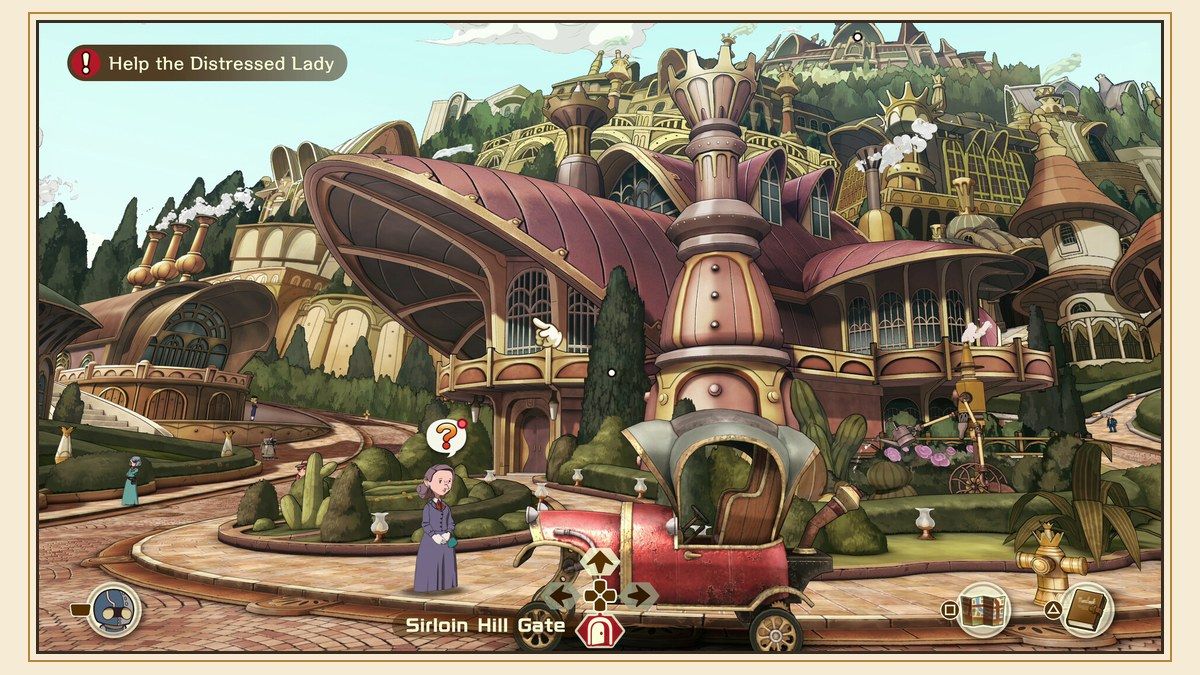
Coindar shortens this, but the habit is still worth having, because a detector tells you something is there, not what to tap.
- Sweep the frame edges first. Coins hide in corners, under furniture, behind railings - anywhere the art has detail. The centre of a room is almost never where they are.
- Tap things that look drawn rather than used. A barrel with visible staves, a clock with legible hands, a book with a title. Detail is the tell.
- Check anything that changes when you approach it. The series has always used small movement as a marker.
- Re-sweep after each story beat. Rooms gain and lose props as the plot moves, and a coin visible in chapter two may not exist in chapter one.
- Do not buy hints until you have swept the current area. Spending coins you could have found in the next room is the classic waste.
Spending them
Hints in this series come in tiers, and the first tier is almost always a restatement of the question rather than the answer. That makes the first hint cheap and the last hint expensive for what it gives you.
The practical rule: take the first hint freely, the second reluctantly, and never the third without trying again first. If you are about to buy a third hint, you have usually misread the question, and a Restart costs nothing.
How Coindar changes it
If Coindar works as described, the puzzle of "where is it" collapses into "walk around with the robot out". That shifts the value of coins: they become a budget you spend on being stuck rather than a reward for being thorough.
Which means the useful habit changes too. With a detector, the thing to protect is your patience, not your coverage. Solve Later and Restart are free; hint coins are not.
After launch
When the game is out, this page gets the actual numbers: how many coins the early areas hold, what each hint tier costs, and whether Coindar has a range limit or runs continuously. That last question matters more than it sounds - a continuous detector turns the whole mechanic into a background task, and a ranged one turns it into a search tool you deploy deliberately.
Until then, the method above is what the series' own design has taught for nineteen years, and it is the part that does not change with the numbers.